Every agricultural programme in Africa eventually hits the same wall. A cooperative list says "Okello Joseph, Eastern Region". A donor report says "farmer 1,247". A buyer's delivery note says "Plot B, Block 3". Three systems, three names, and no way to prove they describe the same tree.
That is not a clerical problem. It is the reason farmer data rarely survives the journey from the field to a lender's credit committee, a carbon auditor's desk or a buyer's procurement file.
The ONE MAP AVOCADO LTD programme in Uganda is fixing this at the foundation, with AgriFAAS Connect (Agricultural Farming-as-a-Service) as digital technology partner. The design principle fits in one sentence: a permanent unique identifier, generated once, never reused, never derived from an administrative name.
Why names are the wrong foundation
Administrative names move. Villages split and merge. Districts get renamed. Parish boundaries are re-demarcated. Transliterations differ between the person filling the form and the person reading it.
When an identifier is built out of those names, every administrative change silently breaks every record that used it. A farmer who was in one sub-county last season is in another this season, and the history that proved their yields disappears with the spelling.
A permanent number does the opposite. It is assigned once, stays with the entity for its lifetime, and can be read by a bank, a land registry, a buyer and an auditor without translation.
The structure of a ONE MAP farm ID
Illustrative Farm ID: UG-EST-UGA-00125-F0001
| Code | Meaning |
|---|---|
| UG | Country: Uganda |
| EST | Region: Eastern |
| UGA | District code (illustrative) |
| 00125 | Village or location reference |
| F0001 | Farm number |
Illustrative format only, not an actual registered farm.
One chain, four levels
| Level | Identifier | What it identifies |
|---|---|---|
| Farmer | UG-FR-000001 | One person, one number, for life |
| Farm | UG-EST-UGA-00125-F0001 | The holding a farmer manages |
| Plot | ...-P001 | A contiguous cultivated unit inside the farm |
| Tree | ...-P001-T0001 | A single tree inside the plot |
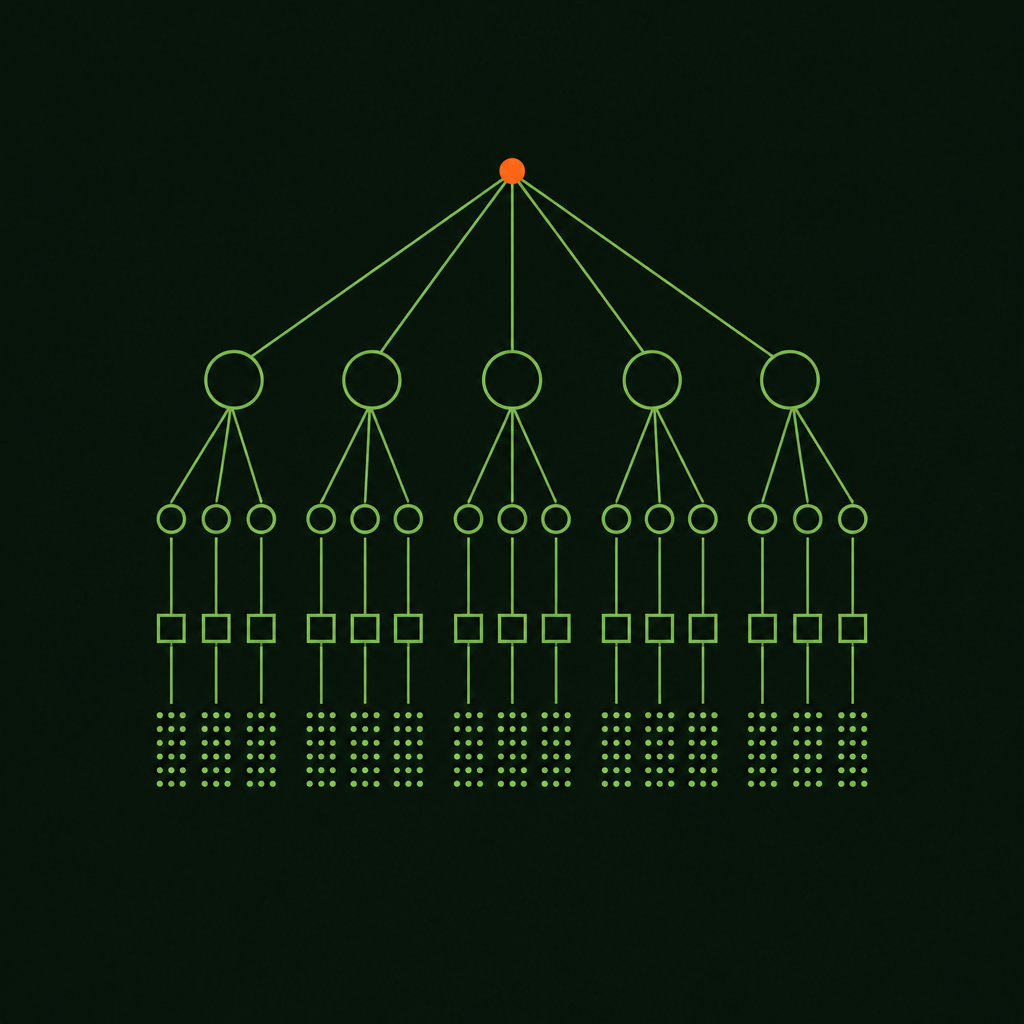
The chain is deliberate. A farmer can hold more than one farm. A farm holds many plots. A plot holds many trees. Each level carries its own number because each level is separately financed, insured, audited or sold. A lender lends against a plot's production. A carbon or biochar programme makes claims per tree or per hectare. A buyer takes delivery from a plot, not from a person.
What a permanent ID unlocks
- Credit. A lender can follow one farmer's record across seasons and across programmes without re-registering them.
- MRV and carbon. Per-tree and per-hectare claims become verified measurements instead of modelled estimates.
- Traceability. A delivery note ties back to a plot, a farm and a named farmer.
- Deduplication. One farmer cannot be counted twice across two registers or two funders.
- Continuity. Farmers keep their record when staff change, partners change or a funding cycle ends.
How it lands in AgriFAAS Connect
The identifier becomes the join key across the platform: the digital farmer registry used by extension officers, field mapping and GPS verification, input allocations, harvest and sales records, and reporting.
GPS plot mapping already links a boundary to a record. The ONE MAP numbering gives that record a stable name that partners, lenders and buyers can use outside the platform, without needing access to it.
Five rules worth keeping
- Never reuse an identifier, even after a record is closed.
- Never rebuild an identifier from a name.
- Keep the location segment immutable once assigned.
- Publish the format so partners and auditors can validate it.
- Treat the identifier as personal data and govern it accordingly.
Where this is heading
The numbering system is a proposed standard for the ONE MAP programme and is being applied as its farmer, farm, plot and tree records are onboarded. Its value grows with use: every bank, buyer and auditor that accepts the same number removes a form, a field visit and an argument from the chain.
If your programme needs one record that a funder, a lender and a buyer can all read, that is the layer we build.