
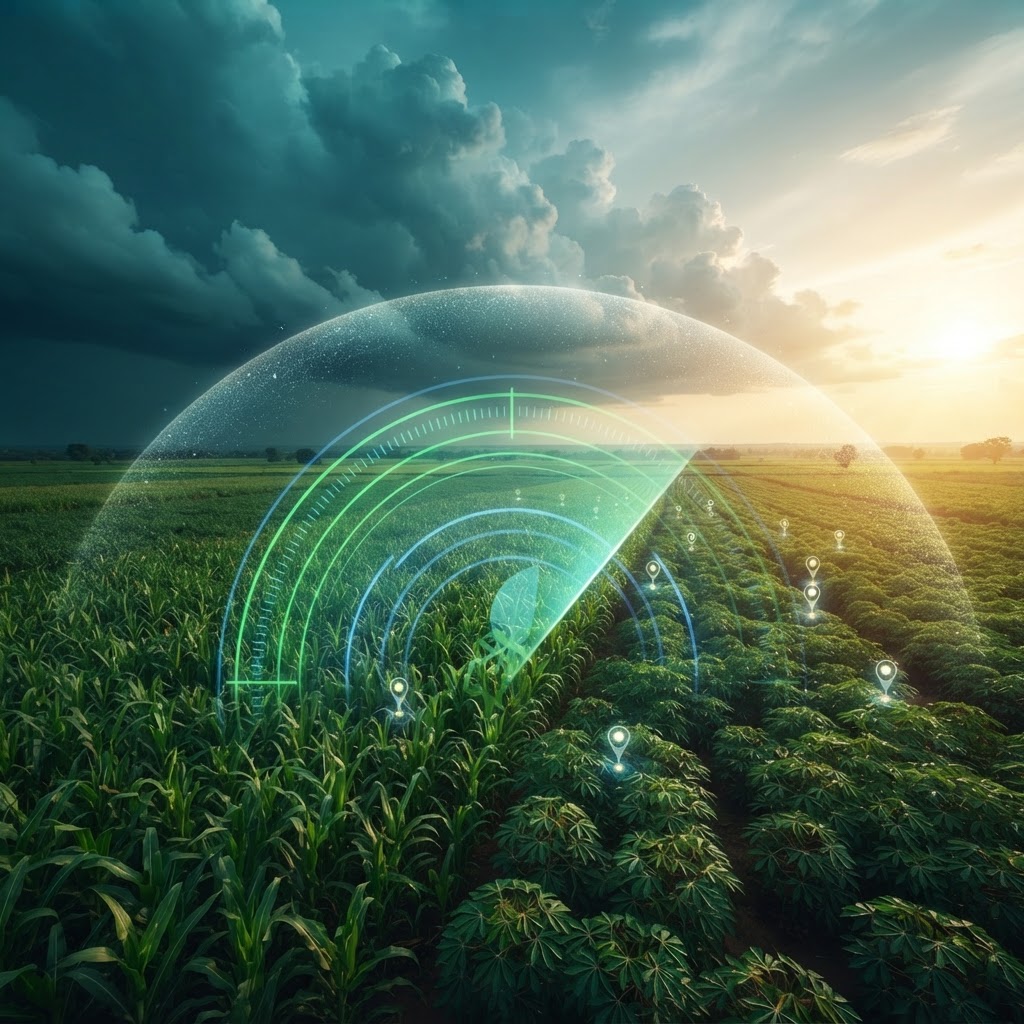
If you can measure it, you can insure it, lend to it, and pay for it. AgriFAAS is the measurement layer.
That sentence compresses everything we have learned building agricultural infrastructure in Ghana — and everything institutions trying to finance, protect or buy from African food-crop farmers need to understand about why the system has stalled. The products exist: the credit, the weather cover, the contracts, the payments. What has been missing, at the farm end, is the measurement that lets each of those products function.
This article explains how parametric weather-risk protection for food-crop farmers actually becomes workable when a verified farm-data layer exists underneath it — and how lenders, insurers, off-takers and programs can plug into ours.
Why parametric cover has underdelivered for African food crops
Parametric insurance is elegant: instead of assessing individual losses after the fact, it pays out automatically when a measurable trigger crosses a threshold — millimetres of rainfall in a defined window, consecutive dry days, wind speed. No loss adjusters, no disputes, money in the farmer's account within days of the event.
For food-crop smallholders it has mostly underdelivered, for one structural reason: basis risk. The payout is indexed to a weather station or a satellite pixel — the farm's actual loss may be quite different from what the index says. A trigger anchored to a district centroid can miss a farmer's drowned plot entirely; or it can pay out for a farmer whose crop, on irrigated land with good drainage, was fine. Either way the product loses credibility, and credibility is the whole product.
The industry's answer is to narrow the distance between the index and the farm. That requires three things farmer-by-farmer: the precise location of the insured exposure, verifiable ground truth about what actually happened on that land, and a trusted local touchpoint to enroll, educate and pay the farmer.
Historically, all three were unmeasurable. Riskwolf AG, the Zurich-based parametric specialist, frames it exactly: if you can measure it, you can insure it. Farmer-level risk in Africa has simply never been measured.
The LoanINSURE pattern: cover embedded in the credit
The structure that convinced me this is moving from theory to market is the work Altimapa Capital — the London structured-capital and debt advisory firm — has done with Riskwolf on LoanINSURE: parametric weather cover embedded directly into farmer loans. A rainfall or cyclone trigger fires, the policy pays out automatically, and the payout covers part of the farmer's loan instalment. The lender's portfolio is protected not by a guarantee riding on top of the loan, but by risk transfer woven into it — with Riskwolf acting as monitoring and claims agent.
When Tosin Adesiyan, Altimapa's Head of Private Credit African Markets, and I began talking, the conversation started from exactly the right place: the 2024 drought, and how to link farms to credit facilities. Because that drought is the live case for why embedded cover matters. Our Bator pilot farm more than tripled revenue in year two (+211%), nearly doubled again in year three (+92%) — then fell 73% in a single drought season. Every input, irrigation and financial record existed. But nothing connected the farm to finance, so there was nothing between that season and a write-off except luck.
A farmer with that profile — a real, measured, food-crop operation whose rainfall risk is visible — is precisely who an embedded parametric cover protects. The missing piece was never the product. It was the measurement that lets the product find the farm.
What a measurement layer contributes to parametric design
AgriFAAS Connect is an offline-first farm management platform — it runs on basic phones in low-connectivity fields and syncs when signal returns — that builds each farmer a verified digital identity: GPS-mapped field polygons, planting dates and crop mix, input and irrigation logs, double-entry financials, plot-level harvest data, and sales receipts tied to named off-takers. Agricultural extension officers capture and verify data inside the same workflow, so the record builds itself from daily fieldwork. Thirty-eight agribusinesses (89 users) run on the platform today, and 111 extension officers have been trained through our internal pilot and webinar series.
For a parametric program, that data layer contributes exactly what the design needs:
- 1. Trigger calibration. GPS polygons anchor the weather index to the actual insured exposure, not a district centroid. Basis risk — the credibility killer of index products — shrinks when the index sees the plot.
- 2. Claims verification. An independent monitoring agent can cross-check automated weather triggers against farm-verified ground truth: planting dates, actual crop status, yield outcomes. That hybrid parametric-plus-evidence base is what makes payouts defensible to reinsurers.
- 3. Portfolio visibility. Lenders and insurers watch distress forming field-by-field — early enough to restructure or trigger, not after default. Continuous verification replaces one-off due diligence, and the cost of knowing the borrower collapses.
- 4. Distribution. Parametric products usually die at enrollment: someone has to explain the product, collect the data and hand over the payout. Our 111 trained extension officers and the Tsiame solar-irrigated farm hub (20 acres in Ghana's Volta Region, first instalment of a 100-acre replication template) are the enrollment, education and payout touchpoints the model has always lacked — and with our satellite weather data partnership (API integration in progress), weather-index calibration has a data path to each farm.
The 2024 drought gives a Ghana pilot something rare: a retrospective calibration benchmark. We know what the rainfall did, and we know — from records — what it did to farms.
Lend to it. Pay for it.
Measurement unlocks more than insurance. The same verified record is what a loan officer prices ("data lending" instead of character lending), and what an off-taker pays against: contracted tonnage from a known plot, with input regime and expected harvest visible, settlement triggered by verified delivery rather than negotiation. Input suppliers extending credit on pay-after-harvest terms get the same de-risking — the repayment capacity is measured, not assumed. And through NOVAC, our investment arm, diaspora and local investors see hub economics on real-time dashboards — investment targets, never guarantees.
One record, four products: insure it, lend to it, pay for it, invest in it.
Who we want to hear from
We are assembling the Ghana pilot for embedded parametric weather protection for food-crop farmers — the LoanINSURE pattern, anchored on the Tsiame hub — and the collaboration surfaces are open:
- Insurers and reinsurers designing index products for West African food crops: bring the structure, we bring trigger calibration, ground truth and distribution.
- Lenders — banks, rural and community institutions, input-credit providers — who want embedded cover in their agricultural portfolios instead of blanket provisioning.
- Off-takers and aggregators who want verified, contractable supply from identified farms.
- Development programs and DFIs funding climate adaptation for smallholders: a pilot site, a data layer, and an M&E framework that produces its own evidence.
The insurance was never the hard part. Neither was the credit, nor the contract, nor the payment rail. The hard part was the measurement — and that is built. Bring the instrument; we will show you the farm.
Website: agrifaasconnect.com | Platform: app.agrifaasconnect.com | Company: curetechnologies.org