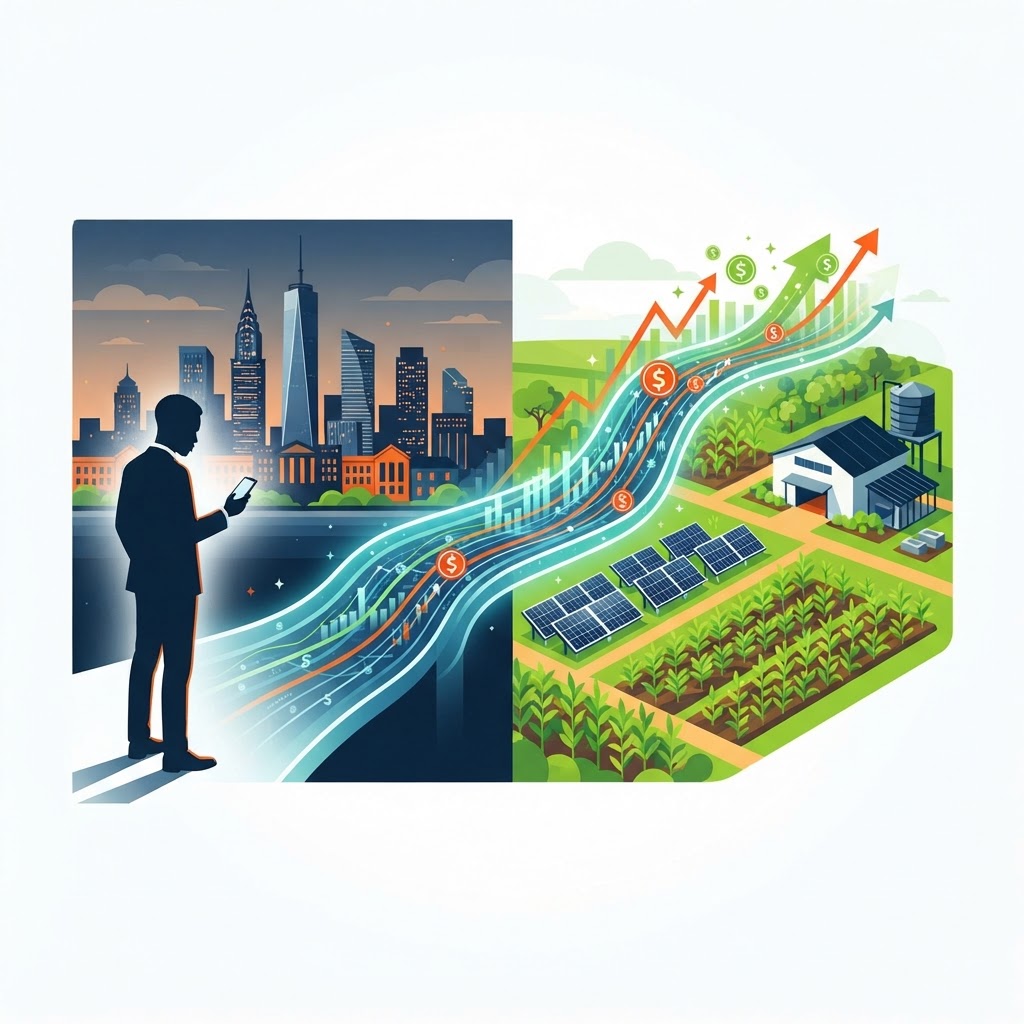
Every year, Africans abroad send home more than $100 billion in remittances — more than official development aid and foreign direct investment combined in many years. It is the continent's largest, most reliable private capital flow. Yet almost none of it is structurally channelled into agriculture, the sector that employs most Africans and holds the clearest growth story. The money arrives, but it rarely invests. It feeds families, pays school fees, builds houses. When it does touch a farm, it too often ends in a story every diaspora family knows: a project back home that quietly failed, managed by a relative, with no records, no contract, and nothing to show for three years of transfers. The problem is not the willingness to invest. It is everything between the willingness and the ground. Five hurdles explain most of it.
1. Information and market asymmetry
From abroad, you cannot see what a local buyer or bank manager sees. There is little reliable, transparent information on agribusiness opportunities, current commodity benchmarks or land values. Daily farm operations, seasonal labour dynamics and shifting local demand are invisible at a distance. Most investment decisions are therefore made on trust and hearsay rather than data — an expensive way to allocate capital.
2. Governance, trust and management gaps
The default diaspora investment vehicle is a family member or acquaintance "managing things back home" — without formal contracts, defined KPIs, or financial accountability. Some arrangements work; many end in mismanagement, quiet abandonment, or fraud. Layered on top: weak institutional trust in administrative and regulatory processes, especially around land, makes formal recourse slow and uncertain.
3. Land tenure and legal obstacles
Customary versus statutory ownership, disputed titles, and long waits for documentation make direct land acquisition risky for non-residents. And where land is available, holdings are fragmented: small, scattered plots resist the mechanization and scale that make commercial farming viable.
4. Infrastructure deficits
Poor roads, inadequate post-harvest handling, thin cold-chain storage and high transaction costs mean crops lose value before reaching buyers. Unreliable power and expensive irrigation capital keep most farms rain-fed — so a single bad season can erase years of investment. We lived this: our own pilot farm's revenue fell 73% in Ghana's 2024 drought because water access and farm data were disconnected from the rest of the business.
5. Financial friction
Sending money to Africa remains among the world's most expensive corridors — fees averaging close to 9% in some cases, according to World Bank data. And there is a shortage of structured products for absentee investors: no agricultural credit guarantees built for the diaspora, few pooled vehicles, no diaspora agribusiness bonds, little co-investment with development finance institutions.
What changes the equation: field-to-finances oversight
Every one of these hurdles is, at its core, an oversight problem. Distance disappears when you can see the farm the way an owner on the ground sees it. Trust gets cheaper when there are records instead of promises. Legal risk shrinks when the operation itself is documented. And capital flows further when less of it is eaten by friction. That is exactly the gap AgriFAAS Connect was built to close. The platform (app.agrifaasconnect.com) is an all-in-one farm management system that turns daily farm activity into verified, structured records: field operations with GPS-verified activity, input and inventory logs, double-entry financials, labour and payroll, harvest and sales. Investors do not have to take anyone's word for the farm's performance; they can read it. Hurdle by hurdle:
| Hurdle | What changes it |
|---|---|
| Asymmetry → visibility | Investment-ready farms carry a live operational record, so a decision made in London, Toronto or Washington can rest on data, not hearsay. |
| Trust → structure | Projects run on defined workflows, documented decisions and audit-ready financials; the records, not the relationship, carry the truth. |
| Land → productive access | You do not need to own land to invest in farming — our AgriFAAS Farm Hubs, standardized solar-irrigated production hubs beginning with our 20-acre Tsiame hub in Ghana's Volta Region, let diaspora capital participate in professionally run production without navigating customary land law. |
| Infrastructure → shared systems | Hub-based production pools irrigation, energy and aggregation infrastructure many smallholders could never justify alone. |
| Friction → structured participation | Alongside the platform, NOVAC — our agri-fintech gateway for diaspora and local investors — is being built to channel these flows into transparent, trackable farm-hub investment with real-time visibility. |
The invitation
If you send money home, you already invest in Africa. The question is whether that money only sustains — or also builds. We are developing the next generation of AgriFAAS Farm Hubs: solar-irrigated, data-managed production centres that create jobs, women's and youth livelihoods, and climate resilience in the communities you come from. If you are in the diaspora and want your capital to work on the continent with full field-to-finances transparency, we would like to talk. Explore the platform at agrifaasconnect.com and app.agrifaasconnect.com. Register your interest in farm-hub development and diaspora investment via the contact form at agrifaasconnect.com with the subject line "Diaspora — Farm Hub Investment." The diaspora already funds Africa's present. With structure, data and accountability, it can build Africa's farms too.
See where your support goes: Our Projects
Track the progress of our farm hubs and regional expansion plans in real time.
Explore Our ProjectsSnapshots from the AgriFAAS Farm Hub, Tsiame (Volta Region)
Current activity on the ground.
Initial diversified production under way on the 20-acre launch hub: cassava, maize, okra, chilli pepper and beans, with coconut establishment, supported by borehole, water storage and solar-powered irrigation.
Initial piggery established with 2 gilts and 1 boar, with an expansion plan toward a 50-pig system and manure management that feeds back into crop production. Poultry, aquaculture and dairy are in planning.
Want to see this hub grow? Reach out and become part of the story.
Sources: World Bank remittance data (annual flows; corridor costs). AgriFAAS Connect own records (2024 drought impact; Tsiame hub). NOVAC is in development; investment figures are forward-looking.
Website: agrifaasconnect.com | Platform: app.agrifaasconnect.com | Company: curetechnologies.org