When Steve Monty of the World Agriculture Forum revealed Terra-Nexus — a $600 million push into African agriculture — the headline number was the least interesting part. The interesting part was the thesis underneath it, the sentence that explains why capital sits on one side of a wall and the continent's 500 million farmers sit on the other:
Capital moves when agriculture is structured, visible and measurable.
Not "capital moves when the money is available." The money has been available. Development finance institutions, blended-finance vehicles, commercial banks and impact funds together hold billions earmarked for African agriculture — against a rural financing gap estimated at $180 billion for African SMEs alone. Yet less than 4% of bank credit on the continent reaches agriculture.
The constraint was never supply. It is legibility. Capital cannot move to what it cannot see, and at the farm end of the system — where the food is actually grown — almost nothing is visible.
The gap is at the farm end, not the fund end
The instruments built to close it — concessional first-loss tranches, credit guarantees, technical-assistance windows — are well-designed. They solve for the lender's fear.
But nothing in that architecture solves for the borrower's invisibility. A loan is not decided in a structuring document. It is decided at a rural bank branch in Ho or Tamale, where a credit officer sits across from a farmer who has ten seasons of real experience, a reputation in the village, and no document that any of it happened. No yield history. No verified cash flow. No record a lender can price.
The financing gap at the farm end is not a capital gap. It is a measurement gap — and no amount of top-of-pyramid structuring closes it. The architecture is waiting for the ground floor.
ARCAFIM proves the design that works
The best evidence that architecture — not subsidy — is what carries risk in African agricultural finance is ARCAFIM, the Africa Rural Climate Adaptation Finance Mechanism launched by IFAD and Equity Group. A $200 million, twelve-year blended structure: roughly $180 million in lending capital plus a technical assistance window, targeting 260,000 smallholders and 500 rural enterprises across Kenya, Uganda, Tanzania and Rwanda.
The tell is that $90 million came from Equity Group's own balance sheet. When a commercial institution puts its own capital into the structure — rather than simply intermediating donor money — it is saying the design de-risks the lending, not the grant. Architecture, not subsidy, carried the risk.
But look at what ARCAFIM's own success factors are: farmer identification, and reliable data. The mechanism works because its borrowers can be identified and their performance can be tracked. Which raises the obvious question: what happens to the same architecture in places where farmers cannot be identified and their performance cannot be tracked?
It stalls. And that is precisely the layer we build.
AgriFAAS Connect: the measurement layer
AgriFAAS Connect is Ghana's verified farm-data layer — the ground floor that instruments like ARCAFIM stand on.
It is an offline-first farm management platform that gives each farmer and agribusiness a verified digital identity: GPS-mapped field polygons, planting dates and crop mix, input and inventory logs, double-entry farm financials, plot-level harvest records, and sales receipts tied to named off-takers. Agricultural extension officers capture and verify data inside the same workflow, so the record builds itself from daily fieldwork rather than from one-off assessments. Today 38 agribusinesses (89 users) run on the platform, and 111 extension officers have been trained through our internal pilot and webinar series.
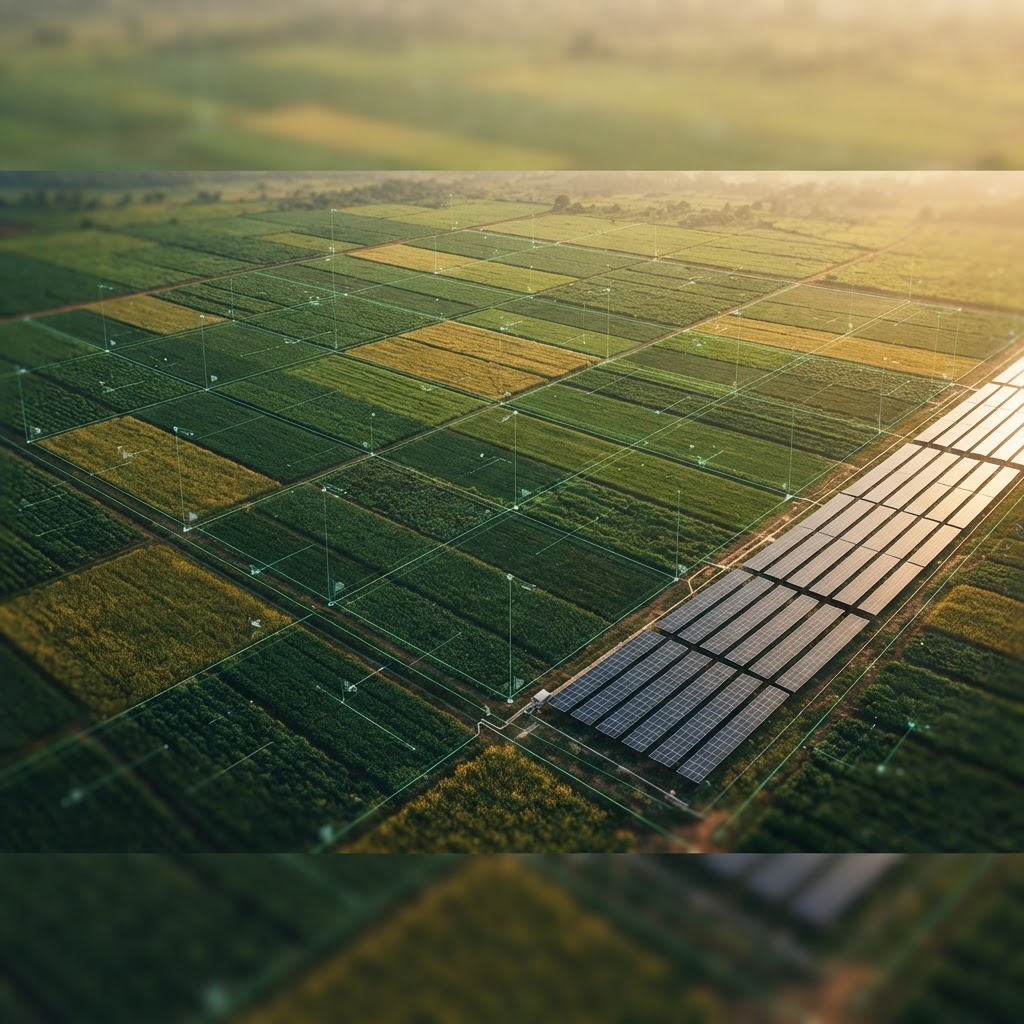
The data layer is anchored by a physical one: our solar-irrigated farm hub in Tsiame, Ghana's Volta Region — 20 acres under construction as the first instalment of a 100-acre replication template. The hub is where farmers aggregate physically: water, inputs, mechanisation, extension and off-take in one place. Together, hub plus platform make farms findable — structured, visible and measurable.
I carry the cautionary tale myself. Our Bator pilot farm more than tripled revenue in year two (+211%) and nearly doubled again in year three (+92%) — then fell 73% in the 2024 drought. The irrigation plans, input records and financial accounts all existed. But they weren't connected to each other, or to any financing partner. No lender could see the farm's story, so no lender could help restructure rather than write it off. That drought is why AgriFAAS Connect was built as one connected system — and why we describe it as the measurement layer: if you can measure it, you can insure it, lend to it, and pay for it.
How organisations can use this — or collaborate with us
We are deliberately building AgriFAAS as infrastructure other institutions plug into, not a closed product. The collaboration surfaces are concrete:
Lenders and rural banks. Use a verified farm history as the underwriting file: season-by-season cash flows, plot-level yields, repayment behaviour over time. The record — not the land title — becomes the collateral proxy. And because verification is continuous, you see distress forming field-by-field, early enough to restructure.
DFIs and blended-finance programs. Guarantees de-risk the bank's balance sheet; a data layer de-risks the portfolio underneath it. Partner with us to give your instrument what ARCAFIM has — farmer identification and reliable data — at the last mile, with continuous monitoring instead of one-off due diligence.
Off-takers and agribusinesses. Verified supply: know the farm, the plot, the input regime and the expected tonnage before you contract it. Our 38 agribusinesses already run on the platform; the hub gives you a physical aggregation and quality-control point.
Extension and development programs. The AEO module puts extension officers and farmers in one workflow — training, farm visits and data capture in one system. Programs funding extension work can adopt the workflow rather than reinvent it; the 111 officers we have trained are the proof it scales.
Partnership platforms like Terra-Nexus. Networks built on the thesis that agriculture must become structured, visible and measurable need exactly one thing per country: a national verified-data layer. We are that layer in Ghana, and the Tsiame hub is the demonstration site where partner institutions can see the whole system working as one.
Investors. Through NOVAC, our investment arm, diaspora and local investors get a transparent window into hub economics via real-time dashboards — investment targets, never guarantees, but visibility where there was only blind trust before.
The invitation
Terra-Nexus has named the thesis. ARCAFIM has proved the architecture. The remaining question in every country is the same: who measures the farm?
In Ghana, the answer exists. We would rather build with you than alongside you — bring the instrument, the program or the market, and we bring the verified farm underneath it.
Get in touch at agrifaasconnect.com — and watch Tsiame.
Website: agrifaasconnect.com | Platform: app.agrifaasconnect.com | Company: curetechnologies.org